

Granger Patios | Which Materials Resist the Freeze-Thaw Better?
Introduction: January in Granger IN, can be challenging for outdoor spaces. One week it is snow, then a thaw, then everything freezes back up again. That back-and-forth is exactly what leads people to wonder whether pavers or concrete will hold up better for patios. If a homeowner is planning a new patio or already has one that is starting to crack or sink, this comparison will help clear up the confusing parts, so keep reading.
Freeze-Thaw Vs Soil Movement Shift in Granger Patios.
Hardscaping Basics For Strong Patio Bases
Freeze-thaw damage is not just “cold weather” damage…it is water damage that shows up in winter clothing too! When moisture soaks into soil or small gaps under a surface, it expands as it freezes and pushes upward. In Granger IN, this can happen more than once in a season because some days are warm enough to melt snow, then drop back down at night. A good base focuses on draining water away fast, not trapping it under stone or under a slab.
Soil movement is a problem in itself, and Indiana soils can be a real mix depending on the neighborhood and how the lot was graded. Clay-heavy areas tend to swell when wet and shrink when dry, creating uneven shifts. This is where hardscaping installation details matter more than the surface material people see on top. A well-compacted crushed stone base can act like a buffer between changing soil and the finished surface.
Pavers And Joints: Flexibility Matters In The Winter
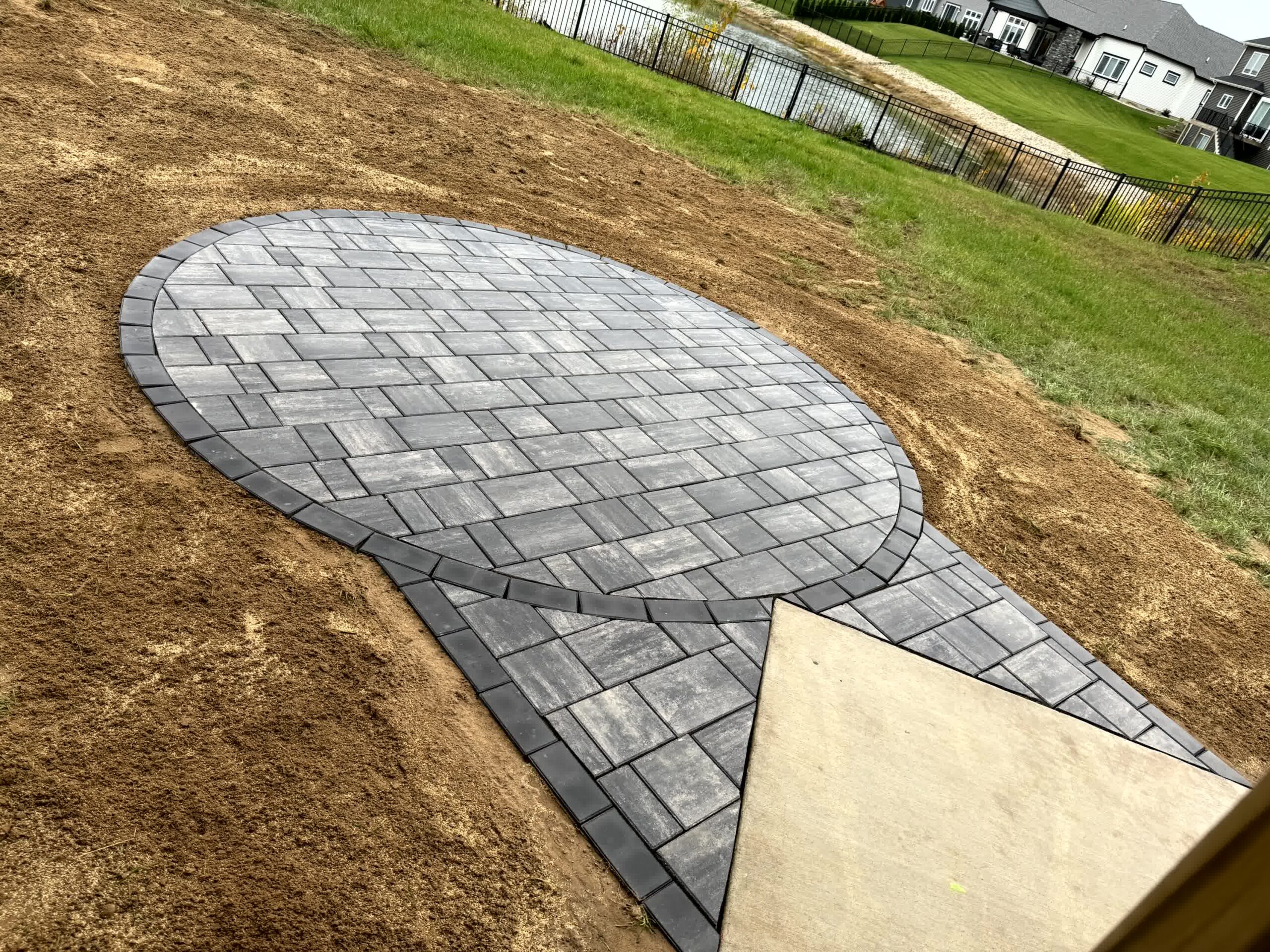
When pavers are installed correctly, they function as a system rather than as individual pieces. The joints allow small movements without causing a single large crack across the entire surface. That is why a paver patio can withstand freeze-thaw cycles and still look normal in spring. If one area lifts slightly, it usually settles back. For patios that sit near downspouts or low areas, that flexibility can be a big deal.
Concrete has inherent strengths, but it does not tolerate movement, even small movement. A slab is a single connected piece, so when part of the base shifts or heaves, stress must be redistributed. Sometimes the slab remains level but cracks; other times it tilts, creating a low spot that retains water. In Granger IN, winters, standing water on surfaces is not a minor issue because it freezes cyclically. For patios that must withstand regular winter stress, the base and drainage plan determine the outcome.

Smart Hardscaping: Concrete and Paver Patios in Granger Soil
Reducing Concrete Damage During Freeze Cycles
Concrete can be a great choice when it is built on the right foundation, poured at the right time, and finished the right way. In a place like Granger IN, the mix matters because freeze-thaw can cause surface scaling when the concrete is not made for it. The preparation under the slab matters just as much because concrete is heavy and requires even support. If the subgrade is soft or the backfill soil was not compacted properly, the slab may settle and crack.
A big misunderstanding is that thicker concrete automatically fixes everything. Thickness improves strength, but it does not eliminate soil movement beneath. Control joints help guide cracking, but they do not prevent it entirely, especially when water continues to enter small openings. A quality crew also pays attention to the slope so water does not pool; pooled water freezes, and that is when edges begin to deteriorate. In January, it is easy to spot slabs that were not properly sloped because they retain a thin sheet of ice in the same area after every thaw.
Maintenance After Ice: Paver Repairs vs. Concrete Patching
When a slab cracks, the fix is usually a patch, an overlay, or a section replacement. Patches can work, but they rarely match the original look and may still fail if the base continues to move. Overlays can look nice at first, but they rely on the slab underneath behaving well, and that is not always a safe bet after repeated winters. Homeowners are often surprised when a repaired crack reopens. It is not because the repair was “bad”; the conditions that caused the crack never stopped.
With a paver surface, repairs are usually more direct. If an area sinks near a walkway edge or a downspout, the installer can remove the units, adjust the base, and reinstall them. The goal is to fix the cause, not just cover up the symptom. That is a significant difference for patios in areas where spring meltwater and frozen ground interact, creating issues. This is also where quality assurance shows up in practice, because the original base depth and compaction determine whether a repair is rare or routine.
Costs, Care, And Long-Term Choices For Patios in Granger
Hardscaping Choices That Cut Patio Costs
Many homeowners start with price, which makes sense because patios are a major project. Concrete often appears less expensive at first glance, especially for a large, simple-shaped open space. It can also be poured fast when the weather is right, which makes it feel like an easy win. The tricky part is that “cost” is not only the installation price; it is also what happens after a few winters, when small issues become visible. If a slab cracks in a noticeable spot, it can affect the overall feel of the space, even if the crack is not dangerous. Stone systems often carry a higher upfront cost because the labor is more detailed and the base work is more involved. Even then, a well-built surface can be a smart choice for patios in problem areas, such as near drainage paths or on lots with known soil shift. If one section settles, it can be corrected without replacing the entire space, thereby protecting the project’s long-term value.Pavers Care Tips For Patios For The Indiana Winter
Maintenance is not a dealbreaker, but it should be understood before the material is chosen. Concrete is usually easy to sweep and hose off, but winter chemicals can cause surface wear over time. Sealing can help, as can being thoughtful about what is used for traction when it is icy. Still, once concrete begins to chip or scale, it is difficult to restore its appearance without additional work. For pavers, the main care is keeping joints in good condition and keeping the surface clean so water does not sit in the same spots. Polymeric sand can help reduce washout and limit weed growth, though nothing is truly maintenance-free. A big plus is that if an area becomes uneven after a rough season, it can be corrected without a full replacement. The best choice is the one that aligns with how the space will be used, how the property handles water, and the level of repair risk a homeowner is willing to carry.
Conclusion
Choosing between concrete and paver comes down to how the surface handles movement, water, and winter stress. Concrete can be strong and clean-looking, but it tends to crack when soil shifts or frost heave exerts uneven pressure. A paver system may cost more upfront, but it is often easier to repair as the ground shifts year after year. If you want help sorting out what will work best on your property, we at Busy Lil Beavers would love to take a look, explain the options clearly, and build it with the kind of quality assurance that holds up in real Indiana winters. Contact us when you are ready, and we will help you build patios that you can actually enjoy.


"*" indicates required fields